


When my son was four months old, my husband decided to take him to swimming lessons.
They spent an hour in the water bonding and playing, and I loved watching them through the window. They were having the time of their lives, but unfortunately, my son wasn’t really learning how to swim.
I assumed he would eventually get there, but the process felt too slow.
When he was three, while staying at a hotel, I noticed he was afraid to jump into the pool, even though I was there waiting to catch him. So I decided to take matters into my own hands and teach him myself.
By the time we came home, he was swimming.
If you want to help your child overcome fear, here are a few things that helped me.
Acknowledge the fear without rushing to fix it
Some fears may appear completely unrealistic or exaggerated.
But underneath that fear, there may be something deeper, like feeling abandoned or not knowing how to cope.
When we give children space to talk without immediately rushing to fix everything, we show them that it’s safe to share, explore options, and ask for support.
Start conversations while drawing or playing
Children don’t always talk about their fears.
My son never told me he was afraid of monsters at a time when I could have done something about it. I only found out years later, after the fear had already passed.
Talking about your child’s drawings or playing with stuffed animals that share difficult feelings is a gentle, indirect way to glimpse your child’s inner world.
Stories about overcoming fear
You can read stories related to your child’s specific fear or any story that encourages courage and growth.
I currently have two stories:
Bobby the Bear and the Nighttime Whispers is about feeling scared and alone at night
Banno and The Big Blue River by Sheeba | This, Right Here is about the fear of swimming
You can also tell stories from your own childhood, from people you know, or create imaginative stories together.
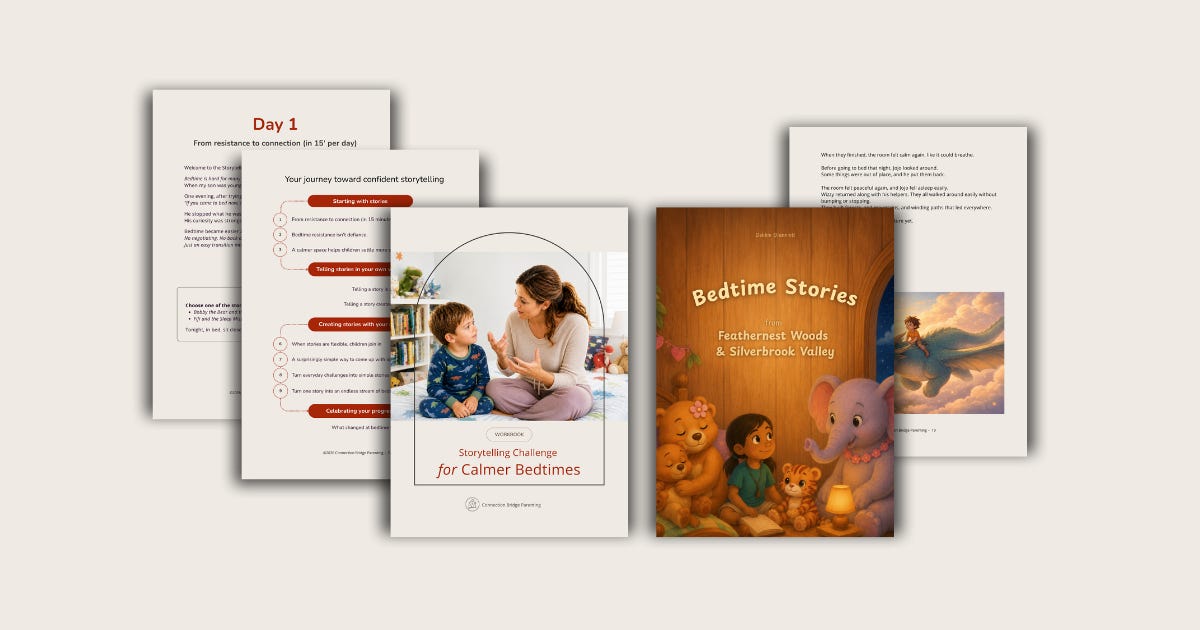
If you’d like to practice creating stories adapted to your child’s life, you can follow the Storytelling Challenge for Calmer Bedtimes.
Shame, judgment, and labels delay progress
As a child, I judged myself harshly and felt embarrassed.
So I never talked about my struggles or asked for support, and brought most of my childhood fears into adulthood.
Sometimes, the judgment and labels come from other people.
“You’re not a baby.”
“Boys aren’t afraid.”
Even well-intentioned comments can turn into limiting beliefs.
I made a choice early on to directly address comments I don’t agree with.
Someone once told my son that Santa Claus only visits children who are “good.”
I immediately looked at my son and, with the calmest and most confident voice I could manage, assured him that Santa Claus loved all children no matter what.
The other person insisted, but I kept looking at my son, and he kept looking at me. It was just noise.
As a not-yet-fully-recovered people pleaser, I found that hard.
It comes easier now, and in the unlikely event that someone keeps pushing, an innocent “Why?” quickly ends the conversation.
Even when I miss the moment, there is always time to revisit the conversation later when I’m alone with my son.
Reframe fear as an opportunity
Challenges create opportunities for connection, trust, and growth.
When we focus on the long-term relationship we are building, it’s easier to stay patient and supportive.
Break everything into very small steps
Before my son could swim, he couldn’t even imagine crossing the pool on his own.
He first needed to feel certain I would be there to hold him, so I held him tightly around the waist while he jumped.
After a few jumps, I started holding his hands instead.
Then I encouraged him to jump on his own, and caught him immediately when he fell into the water.
The next step was to wait a couple of seconds before catching him.
Then a couple more.
After that, I moved a little farther away, so he needed to make a few movements to reach me.
Eventually, I was far enough that he needed to swim toward me on his own.
And that’s when he realized he could float.
Going step by step helped him feel safe. With each step, he built more confidence, and the next step felt easier to take.
Little by little, I removed the scaffolding, and he became more independent.
The delicate balance between encouragement and pressure
One thing I remember from my childhood is my parents insisting I speak to other people.
They couldn’t relate to my extreme shyness, and they assumed their encouragement would be enough for me to do it.
But instead of feeling supported, I felt pressured and judged, even though that was never their intention.
I quickly realized that pretending I didn’t want to talk to people would end the conversation. There was nothing left for them to say after that.
Their insistence felt like pressure because I didn’t have any practical support.
A strong connection creates trust and safety
A strong relationship is built through repeated moments of connection and support.
When your child trusts that you will always be there, courage and growth become easier.
Model overcoming fear yourself
When I decided to start writing on Substack, I had many fears to overcome.
I’ve been sharing that process with my son.
I tell him about my fears, where they come from, and how they’ve affected my life. I show him how I break things into small steps so they don’t feel overwhelming. I show him how I reframe old limiting beliefs into more empowering ones.
I also celebrate my successes.
The inspiring comments from people who find value in what I write.
The exciting collaborations that only became possible after I took a few steps outside my comfort zone.
I do this to inspire him and to show him that growth never ends.
But I’ve also realized that celebrating with a child is the best kind of celebration.
It feels more intense and meaningful.
Choose a repeatable phrase or mantra
A few years ago, my son and I were inspired by Tony Robbins to choose a phrase that would give us strength during difficult moments.
When things got tough, we got into the habit of chanting:
“We are strong… we can do it…
We are strong… we can do it…”
When my son was learning the monkey bars, he kept falling.
To move forward, he needed to let go with one hand while hanging high above the ground. I knew he had the strength to do it, but he kept freezing and falling off.
So I became that mother. You know the one making a fool of herself while chanting:
“You are strong… You can do it!”
People were staring, but I didn’t care.
After falling a few more times, my son got frustrated and wanted to leave. But as we were walking away, something suddenly clicked.
“I know what I was doing wrong,” he said.
We immediately went back, and he crossed the monkey bars in one smooth pass.
This phrase, along with others like “We always find a solution” and “We never give up,” is a part of our everyday life.
Over time, these phrases seem to have gained a force of their own.
They give us both courage and strength when things feel difficult.
Looking back, I realize my son didn’t need me to teach him how to float or how to cross the monkey bars.
His body was already capable of doing those things.
The only thing stopping him was fear.
All he needed was to show him how to move forward despite the fear.
I hope these ideas help you support your child through fear.
If you have anything you would add to the list, I’d love to hear it in the comments.
You’ll find questions, worksheets, and story templates to help your child navigate fear in this premium post: A Practical Toolkit to Help Children Through Fear.
More about fear in these posts:
Fear Is Part true, Part Distortion (understanding fear)
A Practical Framework for Overcoming Fear (a framework for adults)
Children’s stories:
Explore the full library of articles, stories, and parenting resources here.
I loved how you weaved in your story into the topic of fear.
It reminds me a lot of my own experience with my son being afraid of swimming.
He was crying when he had to do swimming lessons, and me pushing him did not help. I needed to understand the underlying issue, connect with him, and guide him through it more. I should have done better.
Thank you for being so vulnerable in sharing your story.
This is so inspiring! Such a beautiful reflection. Beautifully written, Debbie. I’m saving all the tips!